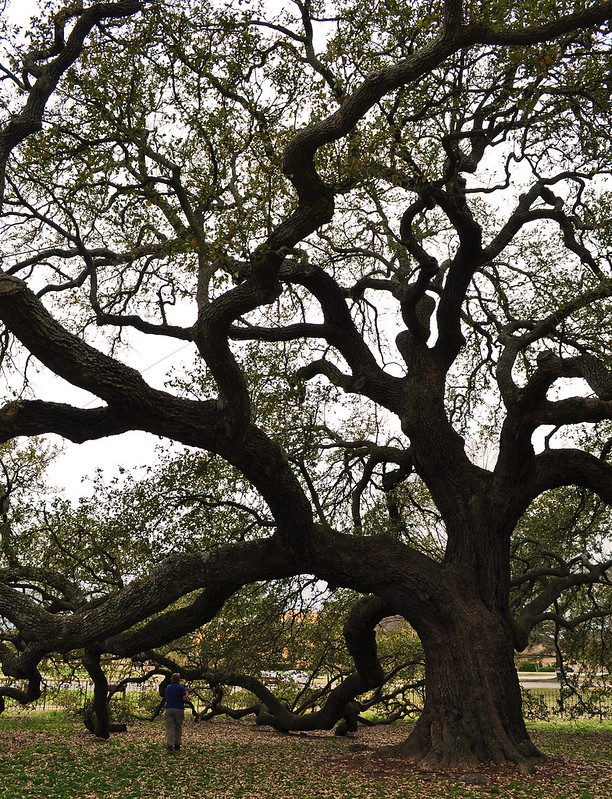
I am so late with this Winter Walk-Off Wrap-Up post that you likely thought I had forgotten about it. Well I haven't; real life sometimes gets in the way of virtual life. This year I had 14 participants, and several who walked in spirit, the needs of their own real lives superseding the virtual. Without further excuses, here are this year's Walk-Offs, in the order that they were received.
#1 - Shirley in San Antonio
Shirley and her sister-in-law walked a three mile loop in downtown San Antonio, a city I have always wanted to visit, mainly for the River Walk. This is a great way to appreciate and celebrate the gift of water in a climate where is can sometimes be scarce. Shirley included many things in this post that I like; Olmec heads, bald cypress, bikes, cormorants, crapemyrtles, and old houses.
#2 - David in Virginia Beach
I was so glad to get an entry from someone nearby, especially from David; I have admired his photography for sometime now. David's walk took place at the Elizabeth River Nature and Canoe Trail. For an area that owes its whole existence to the intersection of water and land, it is nice to see more of us are appreciating these spaces in their more natural state.
#3 - Beth in Wisconsin
In another water heavy post, Beth takes us on a walk by Lake Waubesa, where winter had loosened its grip much earlier than normal. In anticipation of the thaw, fisherman were preparing to haul their ice shacks from the still frozen lake, all the while you can almost hear the crack, drip, and flow of ice turning into water.
#4 - Janet in South Carolina
Janet has participated in every one of my Winter Walk-Offs, which I really appreciate. This year her husband and their dog Skyler walked with Janet as the South Carolina Upcountry was waking from winter. Along they way there was a mystery hole to be discovered, and a symphony to enjoy.
#5 - Hoover Boo in Southern California
Water, or rather the lack of water, also plays an important part of Hoover Boo's walk. This was also the case for her 2015 Walk-Off, and despite the predictions for El Nino, drought will likely be something California gardeners and non-gardeners alike will continue dealing with for some time to come. Her post unfortunately includes many dead trees, but there are also wild pops of color coming from drought-defying bougainvilleas.
#6 - Sarah in Maine
Sarah has participated in several of my Winter Walk-Offs, and they often take place on skis, but not this year. It is hard to imagine a winter in Maine without much snow. Sarah and an old friend of hers stroll through the beautiful Bowdoin College campus, through the quaint town of Brunswick, and then over a swinging bridge designed by John A. Roebling's Sons Co., of Brooklyn Bridge fame.
#7 - Phillip in Vancouver, Washington
Phillip just moved to the Pacific Northwest from Alabama. I am certain this was a big change for him personally, but possibly even more so as a gardener. For Phillip's walk he traveled through his new neighborhood, where there is a diversity of conifers, other evergreens, and many flowering plants. In fact, this is one of the most bloom-filled entries for this year's Walk-Off.
#8 - Peter in Tacoma, Washington
The skies were dreary and gray as Peter took his Winter Walk-Off in downtown Tacoma near the Glass Museum and Union Station, both of which were closed. However, there were a few places open where he could show some of the glassware that his region is famous for. The pieces stood in colorful contrast to what was happening in the skies above.
 #9 - Marilyn in Manteo, North Carolina
Back on this side of the continent, and just south of me, Marilyn took her morning walk through the village of Manteo on North Carolina's Roanoke Island. She captures some of the village's charm, and some of its wildlife, including our second cormorant sighting. Marilyn travels the country volunteering at different National Wildlife Refuges for 4-5 months at a time, and then moves on to a new one. Her stint in North Carolina is coming to a close, and I look forward to her new adventures this summer in Maine.
#10 - Loree in Portland, Oregon
Loree took her walk along Portland's South Waterfront, a former brownfield site, which is now home to many new and modern residential high rises. Her walk also took her back in time to a former life when she was the Marketing Director for one of the development's architectural firms. As a garden blogger, I am glad she now gets to spend her time gardening, photographing gardens, and writing about gardens. Of course she includes a few plants, as well as our third cormorant sighting.
#11 - Ray in Alexandria, Virginia
Directly across the Potomac from Washington is the older city of Alexandria, Virginia. Ray has taken us through its historic streets before, but that is okay, as this remains one of my favorite places in the whole state. This year he saw interesting and historic architecture, and continues with what became an overriding theme - water. In this case too much of it at times.
#12 - Jennifer in Brampton, Ontario
I am sad we only had one international Walk-Off this year, but was glad that it was Jennifer's. She walked us through the fascinating history of her town, which was once home to a large and thriving complex of greenhouses that supplied the country with cut and potted flowers, and in the process employed many people. In fact, the place was formerly known as "The Flower Town of Canada". Today the complex lies fallow, and the once warm greenhouses now grow only weeds.
#13 - Georgia in Arlington, Virginia
In previous Walk-Offs, Georgia took us to London and New York. I think she now does most of her walking in Arlington, which is also across the river from Washington, and next door to Alexandria. When Georgia took her walk, winter was on the way out, and the local landscape was coming alive with redbuds, magnolias, daffodils, hellebores, and forsythia.
#14 - Sweetbay in North Carolina
Water was again the central theme in the last entry of this year's Winter Walk-Off. Sweetbay is fortunate to have a wild creek running near her home. She ventured there in the hopes of spotting wood ducks and wild turkeys. She did see evidence of the turkeys by their many tracks, but did not spot any. However, she scored a nice view of what she terms "the most beautiful waterfowl on the face of the earth", and was able to get several photos of wood ducks.
Before we get to the rich swag portion of our program, I need to mention that my normal method of allowing a thoroughly disinterested teenager to draw names for prizes had to be modified this year, as the thoroughly disinterested teenager has already left for work (his job is crucial for a happy urban populace - quick Chinese food delivery). So I had to resort to an even more thoroughly disinterested entity, a random number generator.
The first number generated was 13, making Georgia the winner of a collection of treasures I have pulled from the shores of the Atlantic.
The second number generated was 2, making David the winner of a surprise prize. I will say it is heavy and looks like it may have fallen out of the rear end of an elephant, but looks can be deceiving.
Congratulations David and Georgia, and
a big thank you to all of this year's participants. I hope everyone had as much fun as I did.
(
The photos used in this post are just some random shots pulled from my camera roll over the last few weeks, some of them will be fleshed out into blog posts, at some point.)